Commercial agent status does not require the power to modify prices: The Court of Justice is in contradiction with the decisions of the French Cour de Cassation

The Court of Justice of the European Union (CJEU) ruled on June 4, 2020 that a person who sells goods in the name and on behalf of his principal does not necessarily need to be empowered to change prices to be granted the legal status of commercial agent.

This position is diametrically opposed to the one of the Cour de cassation and the Cour d’appel of Paris, which required for several years this empowerment of the agent to be qualified as a commercial agent.

The harmonization in European Union of the commercial agent’s status was introduced in 1986 by a Directive (86/653/EEC of 18/12/1986) incorporated into the Commercial Code (Art. L134-1 and following) under which a commercial agent is the person in charge of, on a permanent basis, to “negotiate and possibly conclude sale, purchase, rental or service provision contracts for and on behalf of producers, manufacturers, traders (…)”.

The distribution via a network of commercial agents is particularly suited to the national and international distribution of products and services. For the duration of the contract, the agent does not act in his own name and does not develop his own clientele but that of the principal, who can thus make his brands known and develop his sales on a national or foreign market according to a light mechanism (the agent is remunerated by a commission on sales) through the intermediary of an operator who is familiar with the functioning of this market.

At the end of the contract, the principal retains the clientele developed by the agent, which enables him to establish himself on a long-term basis on the market developed by the agent, through a local subsidiary or a local distributor who accepts the risk of distributing the products and services on its own behalf. On the other hand, the agent loses the fruits of his work. The status of commercial agent provided for by the Directive enables him, on termination of the contract, to claim compensation for the loss or the damage caused by the termination of the relationship (Directive, Art. 17). French law has chosen to compensate the loss caused by the termination of the contract (Directive, Art. 17.3; C. Com. Art. L 134-12), which, according to French case law, has resulted in compensation most often equal to 2 years’ commission calculated over the last 3 years of the contract.

For the last twelve years, and especially since 2014, and despite criticisms, the Cour de cassation, followed by the Cour d’appel of Paris, has been strictly applying the Directive, out of step with the courts of other European States and several other courts of appeal (for instance Lyon and Toulouse). Indeed, although the word “negotiate” does not have a legal definition in French law, they have consistently ruled that the intermediary who does not have the power to modify the terms of the contract with the customer (price and conditions of sale), does not have the power to “negotiate” in the name and on behalf of the principal as provided for by the definition of commercial agent (Cass. com. 15/01/2008, n°06-14698).

This strict interpretation of the term “negotiate” has had significant consequences for the agent under French law. Indeed, the agent who, at the date of signature of the contract believed himself to be protected by the legal status, found himself without this protection and deprived of the termination compensation, if he failed in bringing the heavy and difficult proof of his diligence with the clients, and of his negotiations on the price and his power to modify it.

It is in this context that the Tribunal de commerce of Paris referred a question to the CJEU for a preliminary ruling on the meaning of the word “negotiate” (T. com. Paris, 19/12/2018, n°2017/015204). The issue was important and the decision awaited with interest and impatience by practitioners of distribution law.

The decision of the CJEU of June 4, 2020 is clear and goes against the restrictive position of the Cour de cassation and the Cour d’appel of Paris: a person who sells goods for a supplier does not necessarily need to have the power to change the price to be qualified as a commercial agent.

Therefore, normally, the Cour de cassation and the Cour d’Appel of Paris have no other choice but to go back on their case law and abandon the condition of the power to negotiate prices as a requirement for a commercial agent. However, an arm wrestling with the Court of Justice is not to be excluded.

To industrials, producers and traders who may be concerned about this position, we would like to remind that:

– the amount of 2 years of commissions frequently awarded by the courts as compensation is not mentioned in the law: circumstances may justify a lower amount;

– this position is limited to commercial agency business and cannot be extended to other intermediaries or service providers.

Indeed, the commercial agent must look after the interests of the principal and act loyally and in good faith (Directive, Art. 3). In particular, the commercial agent must “make appropriate efforts to negotiate and, where appropriate, conclude the transactions for which he is responsible”. Although these operations do not necessarily involve the ability to modify the price of the goods, they require him to provide information and advice as well as to hold discussions with potential or existing customers to encourage sales. Only efforts and actions performed in this respect allow the agent to claim for the status of commercial agent and for commission fees on sales if he deploys them on a permanent basis. Thus, an agent who never visits customers or a service provider who is responsible only for advertising operations in a territory cannot claim either the status of commercial agent or any termination indemnity.

Catherine Robin, Partner and Ambre Luciak, trainee.
Foreign investments and Covid-19: France implements a stricter approach

The Covid-19 crisis confirmed and accelerated the recent trend in Western countries to strengthen the foreign direct investments (or “FDI”) screening regulations (see our Newsletter dated March 2019). Indeed, France decided to broaden the scope of that screening and to apply stricter criteria to share acquisition in sensitive companies.

R&D in biotechnologies now subject to authorization

On 27 April 2020, the French Minister for Economy signed a decree adding “biotechnologies” to the list of critical technologies subject to screening when the French target’s business includes research and development in such sector. The list of critical technologies already includes cybersecurity, artificial intelligence, robotics, 3D printing, semiconductors, quantum technologies and energy storage.

As it is the case with all these technologies, there is no legal definition of “biotechnologies”. Given the timing of this addition, it obviously includes research for a vaccine against the Covid-19. But it is certainly broader and aims at protecting French companies active in Life Sciences, not only Human Health, but also animal health or plant genetics. Protecting Public Health is already a objective of the French FDI screening regulation, but it certainly strengthens that screening by preventing any circumvent of it. Finally, it is also consistent with the EU Regulation 2019/452 of 19 March 2019 implementing a European FDI screening framework and cooperation.

Lowering the shareholding threshold from 25% to 10%

Given the downfall of Stock Exchanges with the Covid-19, the risk was too high to see foreign investors – not necessarily friendly… – purchasing shares of sensitive French companies at low price. Therefore, the Minister also decided the temporary lowering of the voting rights threshold in sensitive companies requiring prior authorization.

A prior authorization is mandatory for any takeover (i.e. more than 40% or 50% of the voting rights depending on the definition of control) by a foreign investor of any sensitive French company. This applies to both EU/EEA and non-EU/EEA investors. Such authorization is also mandatory whenever a non-EU/EEA foreign investor crosses the threshold of 25% voting rights within the company (its used to be 33.3%).

The Minister decided to lower that threshold to 10%, under certain conditions:

– this only applies to listed companies,

– this does not apply to EU and EEA investors,

– this measure should end on 31 December 2020,

– a special procedure is implemented, pursuant to which the Minister will have 10 days to decide whether the transaction should be subject to further review (the usual timescale is 30 days).

This measure should enter into force on 1st July 2020, subject to a decree to be first reviewed by the Conseil d’Etat.

* * *

France foreign investment screening in a nutshell

France is one of the most comprehensive regime in Europe, with Germany, Italy and the UK ones: any investment – direct or indirect – through a share deal (i.e. acquisition of a controlling interest or, for investors outside the EEA, of more than 25% of the target company’s voting rights) or an asset deal (i.e. all or part of a branch of activity of a company) in a French entity active in regulated sectors is subject to a mandatory notification and a prior approval by the Minister for Economy.

Regulated sectors include, for both EU and non-EU investors, (i) activities likely to harm interests of national defence, public order or security as such (classified activities related to National Defence, IT systems for public security purposes and data-storage activities) or (ii) activities relating to critical infrastructures, goods or services (in relation to key France assets, energy, water, transportation, space operations, communications, IT systems of Police, Gendarmerie and Customs, critical infrastructure, public heath, agricultural products, press…) and (ii) R&D activities in the abovementioned sectors and related to critical technologies as defined in the Decree of 31st December 2019 (cybersecurity, artificial intelligence, robotics, biotechnologies), and to dual use goods and technologies.

There are no financial threshold to trigger the foreign investment review.

Do not hesitate to contact the Compliance and Regulatory team should you need any further information.

Frédéric Saffroy and Jeanne Quéneudec

New facts to know about French Labour Law

Our employment team has prepared a newsletter on the latest reforms in France that impact all companies with a different format : a brief explanatory video.

For more info on the subject, you can contact Jean-Christophe Brun, Jacques Perotto or Nicola Kömpf (for German-speaking clients).

Find out more about dispute resolution in France and the tax benefits of conducting R&D activities in France.

The impact of Covid-19 on legal procedures in France

What has been the impact of Covid-19 on the operation of courts and court hearings in your jurisdiction?

In response to the coronavirus pandemic, the French government has introduced legislation enforcing the closing of law courts and the suspending of judicial proceedings.

During this period, courts remained opened exclusively to deal with “essential” matters such as: urgent criminal cases with incarceration issues, civil cases with familial and violence issues. Apart from these essential matters, hearings have been postponed.

To this end, few hearings have been taking place having regard to sanitary measures. Those measures include, in particular, rules on minimum physical distancing and the requirement to wear a protective mask, including inside the hearing room.

For “non-essential” matters, hearings have been postponed until further notice.

As the lockdown is progressively being lifted in France, national courts and tribunals are now looking at solutions, in particular technological ones, in order to ensure that hearings take place under optimal conditions.

Has your government passed legislation or issued orders suspending the operation of substantive deadlines such as limitation periods? Have there been changes to procedural time limits which have either suspend or extended relevant time periods or otherwise permitted parties to agree to extensions of time without resort to the courts?

The French government has issued orders effectively suspending the operation of certain substantive deadlines and procedural time limits during a “legally protected period” defined as the period running between 12 March 2020 and one month after the end of the current state of public health emergency (the “Legally Protected Period”). As of 11 May 2020, the state of public health emergency is announced to end on 10 July 2020 – meaning that the Legally Protected Period would end on 10 August 2020 – but that date may change depending on the evolution of the Covid-19 pandemic.

In civil and commercial matters, as per Article 2 of Order 2020-306 of 25 March 2020 (as amended by Order 2020-427 of 15 April 2020), all “acts, appeals, legal actions, formalities, registrations, declarations, notifications or publications” which by law must be carried out within a certain time period expiring during the Legally Protected Period “shall be deemed to have been accomplished in time if it is done within a period which may not exceed, as from the end of the [Legally Protected Period], the time period legally prescribed for taking action, up to a limit of two months”.

In practical terms, that means that both limitation periods and procedural time limits expiring during the Legally Protected Period will start again on the day following the end of the Legally Protected Period for a period of a maximum two months.

As illustrations, based on the assumption that the state of public health emergency will end on 10 July 2020:

– A five-year limitation period expiring on 20 March 2020 is extended until 11 October 2020 (i.e. 10 August 2020 (end of the Legally Protected Period) + 2 months from 11 August 2020);

– A two-year limitation period expiring on 9 August 2020 is extended until the same date (11 October 2020);

– A 15-day time limit to appeal a judgment expiring on 25 March 2020 is extended until 26 August 2020 (i.e.10 August 2020 (end of the Legally Protected Period) + 15 days from 11 August 2020).

Order 2020-306 of 25 March 2020 as amended also has affected the operation of certain contractual provisions. In broad terms:

– the operation of penalty clauses and late payment penalty clauses that were triggered before 12 March 2020 is suspended up to the end of the Legally Protected Period;

– the operation of penalty clauses, late payment penalty clauses, termination clauses and forfeiture clauses, the purpose of which is to sanction non-performance of an obligation within a set timeframe, that were triggered during the Legally Protected Period is suspended until the end of the Legally Protected Period plus an additional time period corresponding to the period during which the debtor was supposed to perform its obligation during the Legally Protected Period.

Besides, French law generally allows parties to agree on the suspension or interruption of limitation periods. This can be done by way of tolling agreements.

What has been the impact of Covid-19 in terms of the enforcement of judgments, including foreign judgments?

Concerning domestic judgments

In France, the enforcement of domestic judgments is carried out through bailiffs, who have authority to attach assets on the basis of an enforceable court decision.

During the lockdown which lasted between 17 March and 11 May 2020, the enforcement of judgments was more difficult in practice because of bailiffs’ limited capacity and ability to perform enforcement acts. It is too early to say whether and for how long the enforcement of judgments will continue to be disrupted in practice, but it is safe to assume that it will remain so to some extent for a few months.

Compulsory time limits for a judgment creditor to perform certain enforcement acts, and for a judgment debtor to challenge such acts before the enforcement judge, have been suspended up to the end of the Legally Protected Period.

The activity of enforcement judges has been drastically reduced during lockdown. It will continue to be disrupted for some time. Throughout the Legally Protected Period, under certain conditions and by exception to the general rule, enforcement judges may hand down judgments solely based on the parties’ written submissions, i.e. without holding a hearing.

Concerning foreign judgments

In civil and commercial matters, the enforcement of judgments rendered in Member States of the European Union, the United Kingdom and Denmark does not require prior recognition by a French court. Enforcement is carried out through bailiffs directly, as for the enforcement of domestic judgments. The impact of Covid-19 on the enforcement of judgments rendered in those jurisdictions is therefore similar to the impact it has had on the enforcement of domestic judgments described above.

Concerning foreign judgments rendered by other jurisdictions, enforcement requires prior exequatur, which is obtained through legal proceedings whereby the enforcing party summons the judgment debtor to appear before the competent French court from which exequatur is sought.

The shutdown of courts during the lockdown period has effectively suspended most court proceedings, including exequatur proceedings. Substantial backlog and associated delays are to be expected when normal operations resume.

Outside of the court system, are litigators conducting their practices (examination of witnesses, mediations, etc) virtually through video-conference platforms?

In response to the coronavirus pandemic, the French government, as many other governments around the world, has introduced legislation enforcing the closing of law courts and the suspending of judicial proceedings. This led French litigators to carry on their practice from their homes, concerning the cases not frozen under the emergency rules.

Litigators have therefore conducted negotiation or mediation meetings with colleagues and clients by way of teleconference or videoconference, such as Zoom or Microsoft Teams.

The Paris Bar also launched several online platforms in order to support litigators’ work before or outside the court system. So far, three platforms are now available: (i) two complementary platforms for mediation procedures and (ii) one platform aiming at supporting litigators’ work during proceedings and enhancing dialogue between parties and the possibility to reach amicable resolution of issues.

Paris Place de Droit, an organization gathering the main actors of the legal industry in Paris, is launching a platform proposing amicable solutions to parties confronted with difficulties related to COVID 19. This platform offers the services of leading GC, judges, attorneys or academics willing to help companies to escape difficulties.

Jacques Bouyssou, Partner in Litigation, Arbitration and White-collar crime.

Protection of industrial property titles – Defence of intellectual property rights during the Covid-19 crisis

Protection of industrial property titles

1. At the French level: The National Institute of Industrial Property (INPI)

The examination and issuance of industrial property titles as well as the publication of the National Commercial and Companies Register are maintained during the Covid-19 crisis. Therefore, the following online procedures before the INPI can still be completed: filing applications of trademarks, patents, designs and dematerialized “Soleau envelopes”, renewal applications of trademarks, payment of patent annuities, registrations of geographical indications.

Concerning the deadlines prescribed by the Intellectual Property Code, the Orders adopted by the French government on March 25, 2020 and April 15, 2020 provide that all time limits occurring between March 12, 2020 and one month after the end of the national state of health emergency (known as the “legally protected period” whose cessation has been set on May 24, 2020 for now) are extended to:

One month after the end of the legally protected period if the initial period was one month (that means until July 24, 2020),

Two months after the end of the legally protected period if the initial period was two months or more (that means until August 24, 2020).

To date, the date of cessation of the state of health emergency scheduled on May 24, 2020 could be subsequently extended regarding the evolution of the Covid-19 pandemic and the recent governmental measures.

According to the INPI, this extension of the time limits will apply to the following procedures: trademarks opposition, payment of patent annuities, trademarks renewal, designs extension, filing of an administrative or judicial appeal, comments from third parties or response to a notification from the INPI.

Finally, the new administrative proceedings for invalidity and revocation of trademarks before the INPI have come into force by the due date of April 1, 2020. Any time limit calculated from that date will be affected by this extension.

2. At the European level

Just like the INPI, both following European institutions have already taken significant measures and have adjusted their functioning to take into account the health crisis:

The European Union Intellectual Property Office (EUIPO) has decided to extend all time limits expiring between March 9, 2020 and April 30, 2020 until May 1, 2020. The following statutory time limits are notably covered by the extension: the payment of basic fees for trademarks application or renewal, the claim of a right of priority, the trademark opposition or the filing of an appeal.

The European Patent Office (EPO) has decided to postpone until further notice all oral proceedings in examination and opposition proceedings scheduled until April 30, 2020. A pilot will be started for opposition oral proceedings by videoconference. All time limits expiring as from March 15, 2020 are extended until May 4, 2020.

3. At the international level: The World Intellectual Property Organization (WIPO)

The WIPO has decided to continue the process of the main applications within its competence, notably those filed through the global IP services and those filed under the different international registrations for patents, trademarks, and designs.

***

For anyone who may be tempted to register the sign “Coronavirus” or “Covid-19” as a trademark, please be informed that some industrial property offices around the world have already ruled over the opportunity to register these trademarks (particularly in the USA and Belgium) and announced that these trademark applications are unlikely to be accepted. In France, the registration of the sign “Coronavirus” or “Covid-19” as a trademark to designate drugs or masks could probably also be rejected by the INPI due to lack of distinctiveness.

Defence of intellectual property rights before French national jurisdictions

All civil and commercial cases pending before the French courts are impacted by the Covid-19 crisis until further notice. Only absolute civil emergencies have been handled by the courts since March 16, 2020, which obviously excludes any intellectual property litigation.

Therefore, the implementation of procedures related to intellectual property issues will not be easy during this national state of health emergency.

Regarding the ongoing proceedings:

• From March 17, 2020, all scheduled hearings are cancelled, and all deliberations are extended.

• All time limits expiring between March 12, 2020 and one month after the end of the national state of health emergency are extended, as recalled above.

• All current time limits which have not expired during this period are maintained.

Please also note that there is no automaticity. Thus, it is still recommended to complete the due diligence within the required deadlines in order to avoid any delays.

Regarding the non-initiated proceedings, no seizure for counterfeiting can be carried out by a bailiff. However, any victim of intellectual property infringement can still prepare his case upstream for future litigation, and in particular by:

• Drafting by a bailiff statements of facts; either an Internet report in order to prove the existence of disputed contents online, or a report of online purchase of allegedly counterfeit goods or works of art in order to demonstrate that they are being illegally marketed, reproduced or represented,

• Collection of affidavits or supporting documents,

• Dematerialized deposit of a “Soleau envelope” before the INPI or a source code before a bailiff or the Agency for the Protection of Programs (APP) in order to give a certain date to the creations.

Finally, the new Securact platform allows that the service documents by a bailiff be performed with the qualified electronic signature, notably serving a writ of summons. If the addressee of the document refuses to give his consent, the bailiff must perform a service “without contact” by going to the addressee’s residence and taking all sanitary precautions.

In any event, all measures shall be taken to adapt the functioning of the litigation proceedings to the exceptional situation. Thus, Article 7 of Order of March 25, 2020 provides for videoconference or any electronic means of communication hearings. According to Article 8, the judge may decide that proceedings will only be conducted in an exclusively written form. Thus, the parties will have 15 days to object, except in summary proceedings.

Corinne Thiérache, Partner, Laura Raimondo and Alice Gautron, Associates.

With the help of Alice Marie, Student Lawyer at the EFB.

COVID-19 and contracts: a “Safe Harbor” period of time

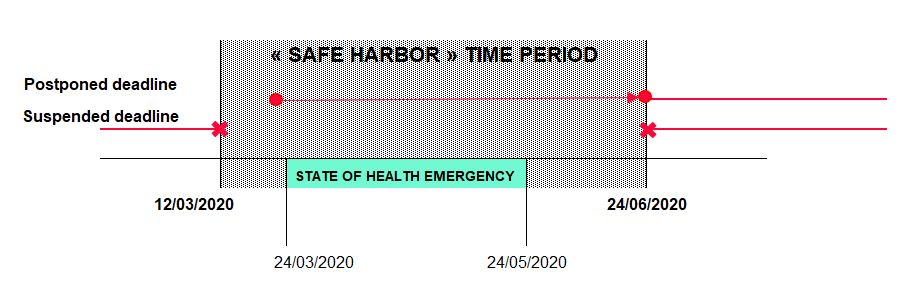
With the lockdown harming the economy, the French Government enacted special measures to provide both flexibility and protection regarding contractual and administrative deadlines. Order No. 2020-306 dated 25 March 2020 on “the extension of time limits during the state of health emergency and the adaptation of procedures during the same period” created a “Safe Harbor” time period during which contractual deadlines and associated sanctions are suspended or postponed.

The “Safe Harbor” time period at a glance: from 12 March 2020 to 24 June 2020

Contract performance difficulties

Contracts usually contain penalty, termination or default clauses intended at protecting one party if the other party fails to perform its obligations within the contractually agreed time limits (e.g. delivery, payment, maturity).

(i) If this contractual time limit ends during the “Safe Harbor” time period, i.e. between 12 March and 24 June 2020, these clauses shall be deemed to not have taken effect.

These clauses will only take effect one month after the end of the “Safe Harbor” time period only, i.e. as from 25 July 2020, provided that the debtor has not performed its obligation in the meantime.

Example: In compliance with the termination clause of your contract, you gave your contractual partner formal notice to fulfil its obligation within 10 days from 6 March 2020. The deadline ends during the “Safe Harbor” time period, i.e. on 16 March 2020. This 10-day deadline will resume as from 25 July 2020 and will therefore end on 3 August 2020.

(ii) If the enforcement of a penalty clause – or the penalty payment – took effect before 12 March 2020, i.e. before the starting date of the “Safe Harbor” time period, it shall be suspended during that period. The countdown will then resume as from 25 June 2020.

Example: A contract provides for a daily penalty if the contractor does not perform its obligation by 27 February 2020 at the latest. On 28 February 2020, the creditor gave formal notice to his contractual partner to fulfil its obligation within 10 days. On 9 March 2020, the penalty payments start to apply. However, as from 12 March 2020, these periodic payments are suspended and will resume as from 25 June 2020 only, if the contractor has not performed its obligation in the meantime.

It is therefore necessary to systematically check:

– If the deadline to fulfil the obligation ends during the “Safe Harbor” time period, in which case its starting point is postponed until one month after the end of that period (i.e. on 25 July 2020), if the contractor has not performed its obligation by that time.

– If the penalty clause or the periodic penalty payments took effect before 12 March 2020, which implies the suspension of the penalty until the end of the “Safe Harbor” time period (i.e. 25 June 2020).

Termination or automatic renewal of contracts

If the deadline to terminate the contract or to give notice (to avoid its automatic renewal) ends during the “Safe Harbor” time period, this deadline is extended two months after the end of that period, i.e. until 24 August 2020.

Example: If you were not able to terminate a contract that is automatically renewed every 31 March, unless giving termination notice during the month before the “anniversary date”, it will still be possible to terminate it until 24 August 2020.

Relationship with the French administration

Suspensions and postponements also apply to relationships with French central, regional and local administrations, public entities and bodies governed by public law (or by private law when they are in charge of public services), including social security bodies.

Decision, approval or ruling to be issued by the administration

If the time period during which a decision, an approval or a ruling from the administration shall/may occur or is deemed to have been taken, ends during the “Safe Harbor” time period, this deadline shall be suspended until the end of the “Safe Harbor” time period, i.e. until 24 June 2020.

If the countdown started to run before 12 March 2020, it shall be suspended until 24 June 2020. The countdown will start again as from 25 June 2020.

If the countdown started to run after 12 March 2020, its starting point is postponed until the end of that period: it will start again as from 25 June 2020.

Example: In case of foreign investments subject to prior authorization from the French Minister of the Economy, the authorization cannot be deemed to have been granted, in case of absence of reply within two months, if this period did not expire before 12 March 2020. Otherwise, the period is suspended and will run again as from 25 June 2020.

Verification of the completeness of a file, request for additional information for the examination of a request, public consultation or participation requested by the administration.

See the previous paragraph. The deadline is suspended or postponed, according to its expiry date or its starting point. This applies, for example, in case of an investigation by the administration.

You should also consult the web site of the concerned administration to find out how it operates during the lockdown (French Anti-Corruption Agency, Competition Authority, Dual-Use Goods Control Office, etc.).

Performance of inspections and work by companies or bringing companies into compliance with requirements

The above rule also applies:

– If the deadline laid down by the administration did not expire before 12 March 2020 (except where the deadline is issued by a Court), that deadline is suspended until the end of the “Safe Harbor” time period (i.e. 24 June 2020).

– If the deadline started during the “Safe Harbor” time period, its starting point is reported until the end of that period.

Example: In case of an order issued on 12 March 2020 by the General Directorate for Competition Policy, Consumer Affairs and Fraud Control (DGCCRF) to comply with a regulation, the deadline for compliance will only run as from 25 June 2020

For categories of decisions, procedures and obligations for which it is not appropriate to suspend time limits, for reasons of protection of the fundamental interests of the Nation, security, protection of health, public sanitation, decrees specify the applicable rules.

Examples: Operators of installations classified for the protection of the environment (ICPE), water structures (dikes, dams), mining installations, pipelines for transportation of hazardous materials, etc. (Decree No 2020-383 of 1 April 2020 derogating from the principle of suspension of deadlines during the period of health emergency related to the covid-19 epidemic).

Alerion’s Commercial Law and Compliance & Regulatory teams are at your disposal to assist you to review your case:

Catherine Robin, Frédéric Saffroy, Partners, Justine Clerc and Jeanne Quéneudec, Associates.

Coronavirus and commercial contracts

Since January 2020, the COVID-19 spread around the world, killing thousands of people and affecting massively business and trade.

This crisis has a major impact on global economy, as many affected countries issued strict lockdown measures for several weeks.

As with previous epidemics, the question will arise whether or not the criteria of Force Majeure are met for contracts subject to French law.

Under French contract law, the legal regime of Force Majeure is a default rule governed by the Civil Code and case law. Moreover, the contracting parties may adjust or exclude it.

The criteria of Force Majeure under French law

The COVID-19 and the issues it generates (illness, lockdown, administrative police measures, etc.) cannot be automatically considered as Force Majeure.

Article 1218 of the French Civil Code defines Force Majeure as “an event beyond the control of the debtor, which could not reasonably have been foreseen at the time of the conclusion of the contract and whose effects could not be avoided by appropriate measures, prevents performance of his obligation by the debtor.”

Thus, an event may be considered as Force Majeure if the following three criteria are met:

• The event is beyond the control of the debtor (external criterion);

• The event could not reasonably be foreseen at the time of the conclusion of the contract (unforeseeable criterion). Parties who have recently entered into a contract may face difficulties to claim force majeure because of this criterion;

• The effects of the event could not be avoided by appropriate measures (irresistible criterion). For instance, the search for a new service provider, or a new supplier.

Case law on epidemics in France

A review of French case law shows that Courts generally refuse to consider epidemics as Force Majeure.

In the past, Courts considered that:

• The epidemic of Dengue fever was recurrent and therefore predictable (Court of appeal of Nancy, 22 November 2010, RG nº 09/00003) ;

• The Ebola virus made the performance of contractual obligations more complex and difficult, but not impossible (Court of appeal of Paris, 29 March 2016, RG nº 15/05607) ;

• The Chikungunya virus was not irresistible since it was generally curable (Court of appeal of Basse-Terre,17 December 2018– n° 17/00739).

However, the current situation may be considered as different from previous crisis, because it affects all countries and international trade, in addition to which large-scale lockdown measures have been enforced by several Governments, including the French one.

It is worth noting that if the introductory report to the Order dated March 25, 2020 (Order n° 2020-306 of March 25, 2020 on the extension of time limits during the period of public health emergency and the adaptation of procedures during the same period) states that “Payment of contractual obligations must still be done on the date stipulated in the contract”, the Order also specifies that ordinary law provisions such as Force Majeure “remain applicable where appropriate if their conditions are met”.

In any case, Courts will decide on a case-by-case basis if the debtor has been unable to perform his contractual obligations due to the COVID-19 and its consequences.

The consequencesof force majeure

If the criteria of Force Majeure are met, Article 1218 of the French Civil Code offers two options:

• If the Force Majeure event is temporary, performance of the obligation is suspended for the duration of that event, unless if that delay justifies termination of the contract.

• If the Force Majeure event is permanent, the contract is terminated by operation of law and the parties are discharged from their obligations. In that case, difficulties may arise if the contract was already partially performed (for example, the supplier incurred costs or the customer has made a down payment).

Parties to a contract may exclude or adjust the effects of Force Majeure on their contractual relationships.

One has to examine in detail, whether and to which extent a particular contractual obligation is concerned and its fulfillment impeded. There may be options to be considered, which could mitigate the impacts on the contract.

We therefore advise:

• To check if the contract includes a Force Majeure clause or excludes such a mechanism. If nothing is mentioned, the legal mechanism of the Civil Code is applicable;

• To check if the legal or contractual criteria are met;

• To identify if the contractual Force Majeure clause includes a mandatory formality that shall be complied with in order to enforce it.

The Hardship mechanism

Even if the Force Majeure mechanism cannot be applied to every cases, the French Civil Code provides a right to renegotiate the contract in case of change of circumstances (the equivalent of a legal hardship provision).

In order to benefit from this mechanism, it must be evidenced that a change of circumstances – that was unforeseeable at the time of the conclusion of the contract – makes the performance of the contract excessively onerous for a party who had not accepted the risk of such a change.

In accordance with Article 1195 of the French Civil Code, that party may request the other party to renegotiate the contract.

In the meantime, that first party shall continue to perform his obligations during renegotiation.

Again, contractors may adjust or exclude this mechanism in the contract. The opt-out clause may concern all contractors or only one of them.

The new mechanisms introduced by the Order of March 25, 2020

On March 25, 2020, the French government issued an Order to protect debtors from the consequences of an unfulfilled contractual obligation.

Article 4 of that Order limits the creditor’s use of several contractual mechanisms (periodic penalties payments, penalty clauses, termination clauses) where they sanction the breach of an obligation that should have been met between March 12, and June 24, 2020 (the date of June 24, 2020 may be postponed if the duration of the health emergency measures is extended in France).

These contractual mechanisms will resume, and be enforceable again, one month after the end of the above period of time if the debtor did not performed his obligation within that time limit.

Article 4 also mentions that periodic penalty payments and penalty clauses which were enforced before March 12, 2020, are suspended between that date and June 24, 2020.

In case of difficulties to meet contractual obligations, we advise analyzing which legal or contractual mechanism (Force Majeure clause, Hardship clause or application of Order dated March 25, 2020) is the most appropriate.

Jacques Bouyssou, Partner and Karadeg Coeffic, Associate in the Litigation, Arbitration and White-collar crime department.

Frédéric Saffroy, Partner in the Commercial Law department.

COVID-19: homeworking and cybersecurity

Following the lockdown measures adopted by the French Government as of 17 March 2020 at 12:00 Paris time, homeworking is the ultimate solution for many companies.

This forced distant working obliges companies to request from their employees a cautious and careful implementation of measures aiming at protecting processed data. Whatever this data is (commercial, financial, technical, legal, administrative, etc.), it is essential to the continuation of your business and the sustainability of your company.

Cyber-attacks (ransomware, phishing, fake president fraud, identity theft, etc.) will not cease during the COVID-19 crisis, and the risks are enhanced by the dispersion of homeworking employees. An IT crisis should not be added to the health crisis.

Below are recommendations based on the assumption that your employees are working from home (these would be stricter if working from a coworking space, a hotel or even in transportation, but this should not be the case with lockdowns):

• Avoid as much as possible the use of devices that are not provided by the company (BYOD): The company cannot monitor, control and secure them as much as its own ones.

• Ensure constant watchfulness on the devices provided by the company, as private residences do not provide the physical protection offered by the company premises: Switch off the laptop and store it discreetly when you leave home; Do not leave the laptop alone in a vehicle, even locked; Do not leave the laptop alone in a place visible from the outside.

• Connect to the company resources only via VPN or via a secured cloud.

• Check that the Wi-Fi used at home is secured and requires a strong password to connect.

• Do not forward your professional emails on your private/personal mailbox.

• Do not plug/connect (physically or via Wi-Fi or Bluetooth) personal devices or third party devices (such as USB keys, SD cards, external hard drives, connected devices, etc.) to the professional laptop of the company.

• Do not allow other family members (even less third parties), including children, to use the laptop.

• Pay attention to any sensitive call or videoconference you may have. Professional discretion still applies.

• Finally, alert your IT manager and your DPO (data protection officer), as well as your security officer (if the company has one) in case of any security incident.

Your vigilance and that of your employees are essential to the integrity of your systems, to the protection of your information and to the sustainability of your business.

For any question, please contact Alerion’s lawyers, and more particularly: Frédéric Saffroy and Corinne Thiérache.

Summary of our privacy policy

This version was uploaded January 2020

As data controller, Alerion is strongly committed to protecting your personal data (hereinafter referred to as "Personal Data" or "Data"), as defined by the General Data Protection Regulation (EU) 2016/679 and by the amended French Act No. 78-17 of 6 January 1978 on Information Technology, Data Files and Civil Liberties (hereinafter collectively referred to as "Regulations").

This Privacy Policy transparently outlines the manner in which Alerion collects, stores, uses and discloses your Personal Data when you visit the Website, accessible on https://www.alerionavocats.com/ (the "Website") and/or when you request services or information offered on the Website (in the “Services" section).

When appropriate, this Policy is supplemented by our General Terms and Conditions of Services, which are attached to Alerion's engagement letter, as well as by the required information provided in our Data Collection Forms.

By using the Website, you accept this Privacy Policy.

More information here